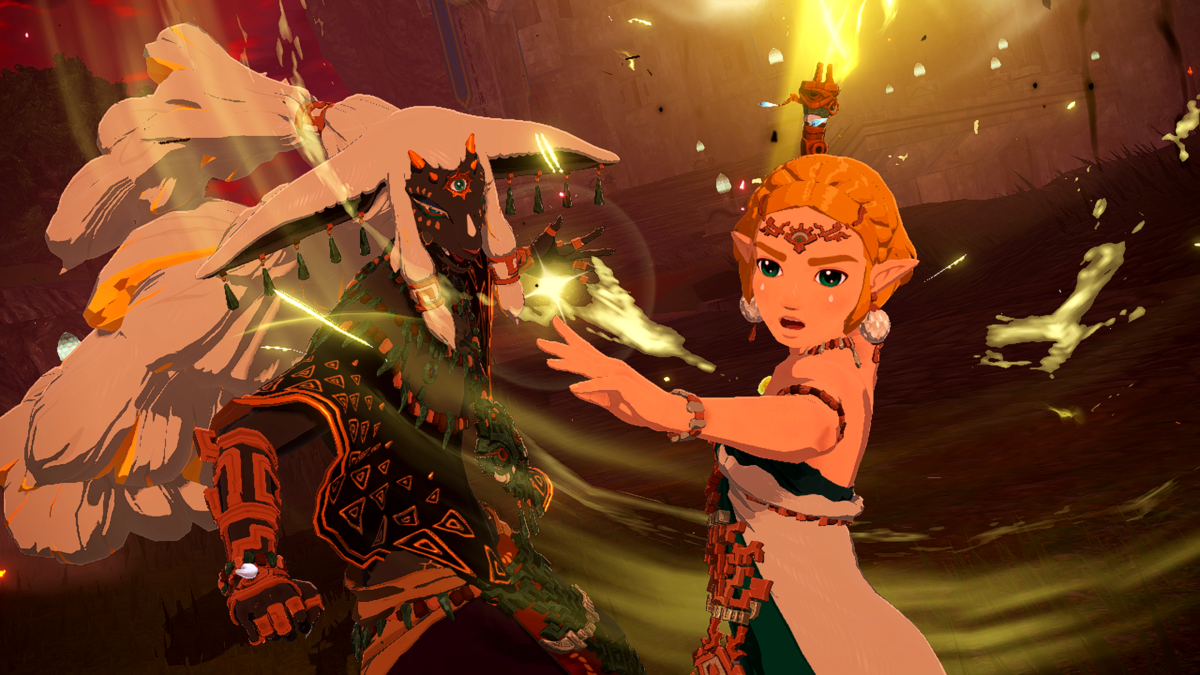
Hyrule Warriors: Age of Imprisonment - A Deep Dive into the Niche Musou Experience
When the original Hyrule Warriors first graced our consoles, it offered a revolutionary blend of the beloved The Legend of Zelda universe with the frenetic, crowd-controlling gameplay of the Musou genre. This initial foray was remarkably accessible, weaving an original narrative that brought together a pantheon of familiar faces, from the enigmatic Sheik and the quirky Tingle to beloved iterations of Link and Zelda. It proved that the Musou formula could indeed be expanded to cater to a vast audience, even those new to the genre. The subsequent entry, Hyrule Warriors: Age of Calamity, deepened this connection by serving as a direct prequel to The Legend of Zelda: Breath of the Wild. While this approach offered a more intricate narrative and introduced characters that resonated deeply with fans of its predecessor, it undeniably required a foundational understanding of Breath of the Wild to fully appreciate its nuances. Now, with the arrival of Hyrule Warriors: Age of Imprisonment, we find ourselves presented with what could be considered the most niche entry in the series to date. Its focused narrative, delving into Princess Zelda’s perspective during the pivotal events preceding The Legend of Zelda: Tears of the Kingdom, coupled with a series of atypical Musou mechanics, presents a unique challenge, potentially making it a more demanding experience for newcomers than its predecessors.
A Spoilers-Rich Prologue to the Imprisoning War
For those who have journeyed through The Legend of Zelda: Tears of the Kingdom, or even merely experienced The Legend of Zelda: Breath of the Wild or Hyrule Warriors: Age of Calamity, Hyrule Warriors: Age of Imprisonment opens with a significant narrative revelation, essentially acting as a substantial spoiler for the overarching lore. The game’s prologue sees Princess Zelda inexplicably transported to the distant past, a period predating the cataclysmic Imprisoning War that pitted the legendary King Rauru and Queen Sonia of Hyrule against the formidable Ganondorf. Upon her arrival in this ancient era, Zelda is discovered by Rauru and Sonia. Recognizing her latent power and seemingly convinced by her account of future events, they extend her sanctuary, presenting her as a visiting relative. What unfolds is a compelling narrative that grants us a front-row seat to Ganondorf’s insidious machinations, the catastrophic surge of malevolent spirits that engulf the land, and the desperate, inspiring efforts of Rauru and Zelda as they endeavor to rally the disparate forces and allies across the kingdom in a valiant fight to reclaim their ravaged lands and push back the encroaching darkness. This narrative framing immediately sets Age of Imprisonment apart, offering a rich tapestry of lore that is both foundational and, for the uninitiated, a potential spoiler minefield.
Pacing and Mission Structure: A Deliberate Evolution
A noteworthy observation regarding Hyrule Warriors: Age of Imprisonment is its pacing, which at times can feel decidedly more deliberate than that of its The Legend of Zelda-themed predecessors, and indeed, many other Musou titles. This nuanced tempo is intrinsically linked to the nature of the narrative, the specific design of its missions, and the gradual unveiling of new playable characters. In the initial stages of the game, players are typically restricted to a mere three playable combatants, with Princess Zelda often being the most familiar face among them. While the game does feature classic Musou scenarios that encourage rapid progression through vast swarms of enemies, the most impactful and memorable moments often arise from more protracted encounters. These segments are characterized by extended narrative sequences, intricate boss battles, and dynamic mission objectives that necessitate a strategic response to enemy actions. Success in these encounters frequently hinges on deploying the correct type of special attack to effectively counter enemy defenses and break through their formidable guard. This departure from the pure hack-and-slash rush of some Musou games signals a conscious effort to imbue the gameplay with a greater sense of strategic depth and narrative consequence.
A Cast of Ancient Legends: Building Familiarity Over Time
Set in the deep past of The Legend of Zelda: Breath of the Wild and Tears of the Kingdom timeline, Hyrule Warriors: Age of Imprisonment introduces a cast of characters who, by their very nature, may not possess the immediate recognition or deep-seated affection that characters from Age of Calamity commanded. While key figures such as Zelda, Rauru, Mineru, and even Calamo are exceptionally well-realized and handled with care, it is acknowledged that some of the Sages, with the notable exception of Ardi, may not immediately forge as strong a connection with players. The process of truly coming to understand and appreciate these characters often requires a significant investment of time and gameplay. This contrasts sharply with Age of Calamity, where the pre-established familiarity with the cast from Breath of the Wild meant that the campaign had less heavy lifting to do in terms of establishing individual identities and fostering player engagement. In Age of Imprisonment, the narrative must work harder to introduce and flesh out its ancient roster, a task that, while ultimately rewarding, demands patience from the player.
Navigating Hyrule: The Sheikah Slate and Overworld Management
Beyond the immediate action of combat and narrative cutscenes, players will find themselves interacting with a comprehensive overworld map, visualized through Zelda’s iconic Sheikah Slate. This interface serves as the central hub from which all missions are selected. The mission structure itself is diverse. Some objectives are straightforward, requiring the delivery of specific items to utilize a Zonai Dispenser, thereby unlocking new device blueprints for use in missions or granting access to new abilities and character attack upgrades. Many of these are brief, rewarding players with valuable materials but leaving a desire for more substantial engagement. The more significant undertakings involve extensive story segments, complex tasks that span larger maps, and strategic deployment of allied characters to simultaneously address multiple situations across the kingdom. These larger missions often culminate in gaining access to previously inaccessible areas. However, it is worth noting that the strategic assignment of allies, while present, may not always feel as polished or effective as in previous iterations. While deployed allies generally reach their designated locations, instances have been observed where their offensive focus and damage output only truly commence once direct player control is assumed, suggesting a minor dip in AI competence for allied units.
Scale and Scope: The Epic Battlefield
A cornerstone of the Musou genre is the exhilarating sensation of traversing vast landscapes and decimating hundreds, even thousands, of adversaries in a single engagement. Hyrule Warriors: Age of Imprisonment certainly delivers on this promise, featuring numerous expansive battlefields where enemy takedown counts routinely climb into the 500 to 1,000 range. While these larger-scale assignments certainly evoke a sense of epic conflict, it is also observed that some of the maps may not feel as sprawling or as intricately designed as those found in earlier Omega Force titles or even some entries within the Dynasty Warriors or Warriors Orochi series. While the scope is by no means disappointing and many battles achieve a genuinely epic feel, there are moments where a comparison to the grander scale of previous titles arises. This is not to detract from the quality of the environments, which are visually rich and thematically appropriate, but rather to note a slight difference in the sheer expanse of some of the arenas.
Character Unlocks: A Gradual Revelation
As previously alluded to, Hyrule Warriors: Age of Imprisonment adopts a more measured approach to unlocking additional playable characters from the The Legend of Zelda universe. This gradual introduction of new combatants is, to a significant extent, dictated by the narrative’s progression. While this slower pace is understandable given the story’s focus on a specific period and its characters, it does mean that for a substantial portion of the early game, players will be limited to a handful of characters for both major and minor missions. The story itself will often dictate which characters are even available for selection. While there is certainly no inherent flaw in Musou games that eschew an immediate barrage of 20+ playable characters, the unlocking cadence in Hyrule Warriors: Age of Imprisonment feels less immediately gratifying than the more rapid character acquisition experienced in previous Hyrule Warriors installments. This can lead to a period where the roster feels somewhat stagnant, delaying the exploration of diverse playstyles.
Mastering the Counter: A Strategic Dance of Offense and Defense
Despite the deliberate pace of character acquisition, the available movesets for each character in Hyrule Warriors: Age of Imprisonment are undeniably impressive, and the implementation of special attacks designed to counter specific enemy assaults is a standout feature. As players progress, their characters gain access to a range of special attacks with distinct properties: some launch projectiles forward, others attack from above, and certain specialized attacks are engineered to penetrate enemy armor. The game brilliantly visualizes incoming threats. When an opponent prepares a powerful attack, a distinctive red hue surrounds them, accompanied by clear visual cues that hint at the most effective type of counter-attack required. The integration of ally assistance further elevates this system; if another playable character is within proximity, a timely button prompt may appear, allowing for an immediate switch to that character to execute the necessary defensive maneuver. This well-executed mechanic introduces a satisfying element of rock-paper-scissors strategy into the combat. However, the system can also present challenges. Frustration can arise when multiple powerful enemy attacks are telegraphed simultaneously on a map where only one playable unit is present, and cooldowns on special attacks restrict the ability to counter more than one assault. Furthermore, encountering a new character who has not yet learned the appropriate counter for a specific enemy attack, or facing a new enemy type for which no counter has yet been discovered, can lead to prolonged and potentially unavoidable battles, as preparedness would have been impossible.
A Symphony of Combat: Ranged Options, Dodges, and Sync Strikes
Beyond the crucial counter system, the combat mechanics in this The Legend of Zelda Musou are exceptionally well-rounded. It feels as though nearly every character possesses a viable ranged option, a crucial tool for efficiently managing enemy hordes positioned at varying distances. The dodge mechanic is responsive and effective; a perfectly timed dodge can initiate a devastating counter-attack, unleashing a rapid flurry of strikes against the stunned opponent. Each character boasts a unique playstyle, with Mineru, for instance, employing Zonai technology in her attacks in a manner that perfectly encapsulates her inventive and technological personality. The ability to wear down opponents’ armor through a combination of standard and special attacks, ultimately exposing a weak point for a visually spectacular and highly damaging critical strike, remains a satisfying core loop. Furthermore, the game features moments where characters can briefly team up with either another playable ally or a nearby NPC to execute a devastatingly powerful and visually impressive Sync Strike. These coordinated assaults are always incredibly impactful, with the Sync Strikes involving Mineru being particularly memorable and satisfying.
Quality of Life Enhancements: Streamlining the Musou Experience
Hyrule Warriors: Age of Imprisonment also incorporates several thoughtful quality-of-life features designed to streamline the player’s experience. During extended campaign missions, players will unlock camps as they advance through the map. By submitting collected items at these camps, players can receive temporary buffs that enhance their combat performance. The options menu offers toggles for automatic item usage, ensuring that characters are healed when their health drops low, and automatically refilling the Zonai device battery when it depletes. The hotkey bar for managing attack layouts is intuitive and easily adjustable. Weapon upgrades are also straightforward to implement. While the game encourages engagement with both major and side missions, it generally avoids feeling excessively grindy; players are unlikely to feel compelled to engage in excessive material farming to progress. A minor quibble noted is occasional camera recalcitrance, particularly during certain dodge maneuvers on specific stages, though this is a relatively minor issue that could potentially be addressed in future updates.
The Enigmatic Sky Segments: A Novel, Yet Uneven, Addition
The inclusion of “sky” segments in Hyrule Warriors: Age of Imprisonment is a novel addition that elicits mixed feelings. These are essentially on-rails flying sequences where players utilize energy and Zonai technology to engage airborne adversaries above Hyrule. While the rockets that automatically lock onto opponents render most other aerial assault methods somewhat superfluous, the overall impact of these segments, outside of boss encounters, feels less pronounced and engaging than traditional ground-based Musou maps. They represent an interesting experiment with the formula, but their execution doesn’t quite reach the same level of satisfying gameplay as the core Musou combat.
Conclusion: A Niche Masterpiece for Dedicated Lore Enthusiasts
In summation, Hyrule Warriors: Age of Imprisonment presents itself as a more niche entry within the The Legend of Zelda Musou lineage. However, for ardent fans of Tears of the Kingdom, its deep dive into the lore and the intricate backstory of the Imprisoning War will likely be a significant draw. The game effectively utilizes its campaign missions to gradually unlock and explore various regions of Hyrule, masterfully weaving its narrative and emphasizing the critical importance of confronting named and major antagonists. At the very least, Hyrule Warriors: Age of Imprisonment showcases Omega Force’s willingness to experiment and evolve its established formula. Ultimately, it is an intriguing Musou title, though its unique focus and narrative demands suggest it is best suited for a very specific, dedicated audience.
Hyrule Warriors: Age of Imprisonment is slated to release on the Nintendo Switch 2 on November 6, 2025.