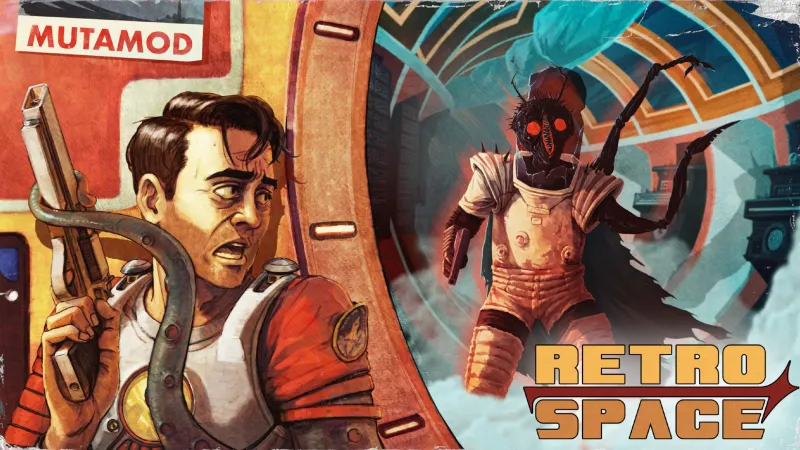
RetroSpace Devs Forge Unconventional Disco-Punk Space Horror Immersive Sim: ‘The Game Will Not Hold Your Hand At All’
At Gaming News, we are constantly on the lookout for titles that push the boundaries of their respective genres, and the immersive sim space, a realm we hold in particularly high regard, continues to be a fertile ground for innovation. While this genre has a rich, decades-long history, developers like The Wild Gentlemen are breathing new life into its core tenets, offering experiences that are both deeply familiar and refreshingly novel. When the promise of a strange space station, reminiscent of the atmospheric dread of System Shock, collides with palpable horror elements, our interest is piqued. Add to this a truly unique aesthetic and a distinct tone, and you have our undivided attention. This is precisely why we are thrilled to delve into the upcoming disco-punk space horror immersive sim, RetroSpace, developed by The Wild Gentlemen and slated for publication by Kwalee. For those who closely follow the immersive sim landscape, the name RetroSpace might already be on your radar. For those new to its allure, The Wild Gentlemen eloquently describe it as a “disco-punk space horror where you can be a sneaky chap or a mutant action hero as you try to survive on a space station swallowed by a black hole.”
This ambitious adventure is poised to be a mind-bending ride, replete with bizarre creatures, intricate immersive features, jarring time jumps, and, fittingly, a touch of ’70s flair. Its influences are cited as legendary titles that have defined the genre: System Shock 2, Thief, Deus Ex, BioShock, and Prey. These are foundational pillars of immersive sim design, and their inclusion as direct inspirations immediately signals a commitment to player agency, emergent gameplay, and intricately designed worlds. We had the opportunity to witness these elements firsthand in an exclusive gameplay trailer, further illuminated by the insightful commentary of Creative Director Bánk B. Varga.
A Janitor’s Descent into Cosmic Terror: The Premise of RetroSpace
In RetroSpace, players are thrust into the role of an ordinary janitor, a character archetype far removed from the typical space marine or hardened operative. This humble protagonist finds themselves unceremoniously plunged into the terrifying abyss of deep space, facing the existential threat of black holes and navigating the disorienting phenomenon of mysterious time jumps. Yet, in a twist of fate that defines the game’s narrative arc, this unlikely hero becomes humanity’s last hope. The core objective involves traversing the sprawling and increasingly hostile environment of the Aurora 5 space station to unravel the catastrophic events that transpired. This journey is fraught with peril, demanding players to either avoid or confront a menagerie of grotesque enemies and mutated creatures that have claimed the station as their own. The threats are as varied as they are disturbing, ranging from unsettling humanoid insects and predatory, fang-bearing plant creatures to hulking massive mutant pigs and eerily smiling, skin-crawling humans.
Immersive Systems and Emergent Gameplay: The Core of the Immersive Sim Experience
At its heart, RetroSpace is an immersive sim, a genre celebrated for its deep simulation of game mechanics and its allowance for emergent gameplay. The recent gameplay trailer provided a compelling glimpse into how players can interact with its various physics and systems to overcome challenges. The environment is not merely a backdrop but a dynamic toolset. Players can, for instance, strategically light oil on the ground to engulf enemies in flames, creating an explosive environmental hazard. Conversely, the ability to take out the lights above you to darken a space opens up avenues for stealth and subterfuge. Combat and approach are equally flexible; players can choose to go in with wrenches blazing, embracing a more direct, action-oriented playstyle, or opt for a stealthy approach, using the environment and their abilities to outmaneuver and neutralize threats without direct confrontation. This emphasis on player choice and environmental interaction is a hallmark of the best immersive sims, and RetroSpace appears to be leaning heavily into this philosophy.
Defining “Disco-Punk” Space Horror: A Unique Aesthetic and Tone
We had the distinct privilege of conducting an in-depth email interview with Bánk B. Varga, Creative Director at The Wild Gentlemen, to gain further insight into the multifaceted design of RetroSpace. When asked to elaborate on the “disco-punk” descriptor and what defines RetroSpace as a disco-punk space horror game, Varga provided a illuminating explanation. “The name disco-punk comes from the fact that the game specifically evokes the atmosphere of the disco era, i.e., the 1970s, and the unique charm of classic sci-fi movies of the time, such as Logan’s Run, Buck Rogers, and Silent Running, just to name a few,” he explained. “In addition, the game is characterized by a unique sense of humor, and horror – psychological horror in particular – is also one of the main elements of the game. This strange blend gave rise to the term ‘disco-punk space horror’.” This fusion of retro-futuristic aesthetics, a darkly humorous undertone, and deep psychological dread promises a gaming experience that is stylistically distinct and thematically compelling.
Immersive Sim DNA: Honoring the Pantheon of the Genre
The profound influence of titles like Prey, System Shock, and Dishonored on RetroSpace is undeniable, and Varga elaborated on the deliberate choice to embrace the immersive sim as the game’s core genre. “The immersive sim nature was one of the first things we agreed on when we started designing the game,” Varga stated. “We are huge fans of the Thief series, the System Shock games, Deus Ex, Prey, and many others. We wanted to make a game that has a strong narrative thread, but still gives the player a high degree of freedom, encourages experimentation and out-of-the-box thinking, and doesn’t hold the player’s hand.” This commitment to player autonomy is a cornerstone of the genre, fostering a sense of genuine exploration and problem-solving. Varga further emphasized, “We wanted players to immerse themselves not only in the game setting, but also in the myriad of game systems, too. We wanted them to constantly be thinking about how they could outsmart not just the enemies in the game, but the game itself and us devs.” This ambition to create a systemically rich world that challenges players to think critically and creatively is a testament to the team’s dedication to the immersive sim ethos.
Mutamods and the Perils of Cloning: Customizable Abilities and Replayability Mechanics
RetroSpace introduces two key mechanics designed to enhance player customization and deepen the gameplay loop: Mutamods and a unique cloning system. Varga explained the genesis of these features. “We definitely wanted to give players some kind of special abilities, and that’s how Mutamods came about,” he revealed. “These are mutations derived from animal genes that allow players to create their own ‘builds’ in the form of specific combinations of these special abilities. These include passive and active, and offensive and defensive Mutamods, so some support open confrontation, while others support stealth.” This system allows for a remarkable degree of player expression, enabling diverse playstyles. Beyond Mutamods, players also have access to tech gadgets, offering further flexibility. Players can choose to rely solely on Mutamods, exclusively on gadgets, mix both, or even forego these enhancements entirely, showcasing the game’s commitment to player freedom.
The cloning system serves a crucial narrative and gameplay purpose: to explain the protagonist’s ability to return to life after death. “We wanted to use the cloning system to explain in-lore why the player can come back to life again and again,” Varga stated. “Our protagonist is a janitor whose job is extremely dangerous and often ends in death, so Aurora 5, the space station, is able to clone them indefinitely.” However, this ability comes with a significant caveat. “Unfortunately, cloning is not always perfect, so each time you are reborn, you will get a kind of ‘cloning error,’ a negative effect that you will have to adapt to,” he elaborated. This mechanic introduces a persistent challenge, forcing players to strategize around these evolving handicaps. “You can remove this effect by extracting the genetic material from your corpse, thereby cleansing yourself of the effect.” Varga noted that this system draws inspiration from Soulslike games and the mechanics of Void Bastards, demonstrating a thoughtful integration of established design principles with a fresh execution.
Beyond the Single Playthrough: Replayability Through Player Choice and Unpredictable Challenges
The concept of “no two playthroughs are the same” is a compelling promise for any game, and Varga clarified what this means for RetroSpace. “The game does have a somewhat fixed main storyline, but beyond that, the player is free to decide on a lot of things,” he explained. “There are side missions and collectibles, and often the game opens up completely and lets the player decide what to do and in what order.” However, the primary driver of replayability lies in the game’s inherent systems. “What makes the game replayable the most is the variety of features, tools, abilities, and combinations available to overcome any problem, be it an enemy, a puzzle, or just a locked door.” This modularity of solutions is a cornerstone of successful immersive sims.
Varga underscored the design philosophy behind RetroSpace: “From the beginning, we designed the game so that most problems can be solved in many different ways, and the game rewards you for trying to think outside the box.” This encouragement of creative problem-solving is paramount. “Of course, there will be simple problems with simple solutions, but for the most part, you will be free to do as you please, and the game will not hold your hand at all, so don’t expect glowing quest markers or yellow-painted platform edges.” This explicit rejection of hand-holding is a bold statement, promising a challenging and rewarding experience for those who embrace its complexities.
Furthermore, the cloning errors are a significant factor in ensuring replayability, as they are “guaranteed to cause unexpected situations.” This unpredictable element ensures that even familiar scenarios can present new challenges. Adding another layer of depth, RetroSpace will feature a total of eight different endings, intricately tied to the player’s choices and actions throughout their journey. This branching narrative structure, combined with the emergent gameplay systems and the randomness introduced by cloning errors, ensures that each playthrough of RetroSpace will offer a unique and deeply personal experience.
RetroSpace is slated for future release on PC via Steam. Players eager to embark on this disco-punk space horror adventure can wishlist the game on Steam now. The promise of a deeply interactive world, a unique aesthetic, and a commitment to player freedom positions RetroSpace as a highly anticipated title within the immersive sim genre, one that we at Gaming News will be watching with keen interest. The dedication to creating a game that respects player intelligence and encourages emergent storytelling is a philosophy we wholeheartedly endorse and celebrate. This is not just another space shooter; it is a meticulously crafted world designed for those who crave genuine agency and a truly unforgettable journey into the unknown.