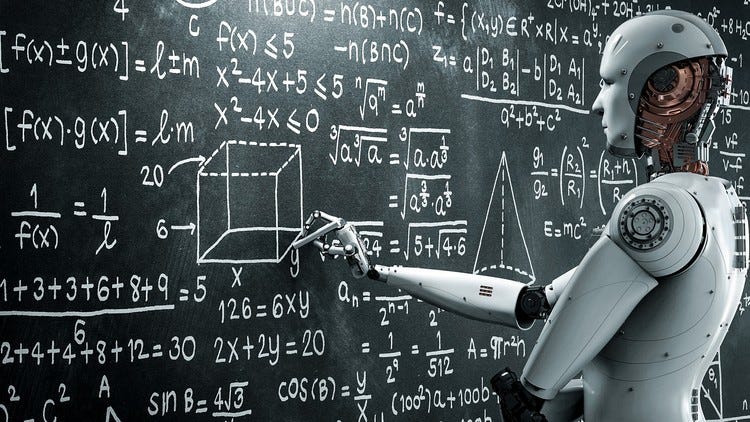
How Artificial Intelligence is Revolutionizing the Application of Mathematics in Our Daily Lives
Mathematics, a discipline historically perceived as the exclusive domain of academia and complex problem-solving, has undergone a profound metamorphosis. No longer confined to the abstract realms of textbooks and lecture halls, mathematical principles are now seamlessly integrated into the fabric of our everyday experiences, often operating behind the scenes, thanks to the transformative power of Artificial Intelligence (AI). This pervasive influence has democratized mathematical application, making sophisticated computations accessible and practical for everyone, fundamentally altering how we interact with and benefit from quantitative reasoning.
The advent of AI has served as a powerful catalyst, bridging the gap between abstract mathematical concepts and their tangible, real-world utility. It has moved mathematics from a subject of mere academic pursuit to an indispensable tool for navigating the complexities of modern existence. From the personalized recommendations we receive online to the optimized routes our navigation apps suggest, AI-powered systems are constantly leveraging mathematical models and algorithms to enhance our lives. We are witnessing a paradigm shift where mathematical operations, once requiring dedicated study and effort, are now automated, predictive, and intuitive, driven by intelligent systems that learn, adapt, and evolve. This article delves into the myriad ways AI is fundamentally changing the way we use math in everyday life, exploring its impact across various domains and illustrating its pervasive, often invisible, presence.
The Unseen Mathematical Engines of AI in Everyday Operations
At its core, Artificial Intelligence is built upon a foundation of sophisticated mathematical principles. Concepts like calculus, linear algebra, statistics, probability, and discrete mathematics are the bedrock upon which AI algorithms are constructed. These mathematical frameworks enable AI systems to process vast amounts of data, identify patterns, make predictions, and learn from experience, all of which are crucial for their functionality in our daily lives.
Data Analysis and Pattern Recognition: The Statistical Backbone
One of the most significant ways AI impacts our daily use of math is through its prowess in data analysis and pattern recognition. Every digital interaction we have, from browsing the internet to using social media, generates a colossal amount of data. AI algorithms, powered by statistical models, meticulously sift through this data to uncover trends, correlations, and anomalies. This capability allows for the personalization of our digital experiences. For instance, e-commerce platforms employ AI to analyze past purchase histories and browsing behavior, using statistical probabilities to recommend products we are likely to be interested in. Similarly, streaming services predict our entertainment preferences based on viewing habits, employing regression analysis and clustering algorithms to curate tailored content suggestions. The underlying mathematical computations are often hidden, but their effect is a more engaging and efficient user experience, demonstrably influenced by advanced statistical applications.
Predictive Modeling for Smarter Decisions
The ability of AI to predict future outcomes based on historical data is another cornerstone of its everyday impact. Predictive modeling, a field heavily reliant on statistical and mathematical forecasting techniques, is employed in numerous applications. Consider the weather forecasts we rely on; sophisticated AI models process meteorological data, employing time-series analysis and Bayesian inference to predict weather patterns with increasing accuracy. In finance, AI systems analyze market trends, economic indicators, and individual investment behaviors, using portfolio optimization algorithms and risk assessment models to guide investment decisions. Even in our personal lives, AI influences choices related to health and wellness, with wearable devices analyzing biometric data to predict potential health issues or optimize workout routines, utilizing calculus-based physiological models and statistical anomaly detection.
Optimization and Efficiency: The Algorithmic Advantage
Optimization algorithms, deeply rooted in mathematical principles like calculus and operations research, are instrumental in how AI enhances efficiency in our daily routines. These algorithms are designed to find the best possible solution from a set of options, considering various constraints and objectives.
Navigation and Logistics: The Power of Graph Theory
When we use GPS applications for navigation, we are benefiting from AI-driven graph theory and shortest path algorithms. These mathematical frameworks analyze road networks as a graph, with intersections as nodes and roads as edges, to calculate the most efficient route based on distance, traffic conditions, and estimated travel times. AI continuously refines these calculations by processing real-time traffic data, dynamically rerouting us to avoid congestion. This not only saves time but also reduces fuel consumption, demonstrating a practical application of complex mathematical concepts in everyday transit. The efficiency gained through these optimized routes is a direct result of AI’s ability to solve intricate mathematical problems that would be intractable for humans to compute in real-time.
Resource Management and Scheduling: Maximizing Output
Beyond navigation, AI-powered optimization techniques are revolutionizing resource management and scheduling across various sectors. In public transportation, AI optimizes bus and train schedules to minimize wait times and maximize passenger throughput. In logistics and supply chain management, AI algorithms determine the most efficient delivery routes for goods, ensuring timely arrival and minimizing operational costs. Even in our homes, smart thermostats use AI to optimize heating and cooling, learning our habits and predicting energy needs to reduce waste, applying control theory and optimization principles to manage energy consumption effectively.
AI’s Impact on Specific Everyday Mathematical Applications
The influence of AI on how we use mathematics extends to highly specific, yet common, applications that have become integral to our modern lives. These impacts range from enhancing our financial literacy to simplifying complex calculations we once had to perform manually.
Financial Management: From Budgeting to Investment Guidance
Artificial Intelligence is significantly transforming how individuals manage their finances. Personal finance apps, powered by AI, go beyond simple transaction tracking. They employ mathematical models to analyze spending patterns, identify areas for potential savings, and forecast future financial scenarios.
Automated Budgeting and Expense Tracking
AI algorithms can automatically categorize expenses, track budgets, and provide alerts when spending limits are approached. This leverages statistical classification techniques and pattern recognition to understand where our money is going. Furthermore, AI can generate personalized budgeting recommendations based on our income, spending habits, and financial goals, utilizing optimization algorithms to suggest the most effective allocation of funds. This makes financial planning more accessible and less daunting, transforming complex financial data into actionable insights derived from mathematical analysis.
Algorithmic Trading and Robo-Advisors
In the realm of investments, AI has democratized access to sophisticated financial strategies. Robo-advisors, AI-powered platforms, utilize quantitative analysis and portfolio optimization algorithms to create and manage investment portfolios tailored to individual risk tolerances and financial objectives. They can automatically rebalance portfolios based on market fluctuations and economic indicators, employing complex mathematical models to make informed decisions. This means individuals can access investment management services that were once only available to high-net-worth individuals, all powered by the mathematical prowess of AI.
Healthcare and Wellness: Predictive Insights from Data
The healthcare sector is witnessing a profound impact from AI, with mathematical principles at its core driving advancements in diagnosis, treatment, and personal wellness.
Diagnostic Assistance and Predictive Health
AI algorithms are being trained on vast datasets of medical images and patient records, enabling them to assist in the early detection of diseases. Machine learning models, such as convolutional neural networks, trained using principles of linear algebra and calculus, can identify subtle patterns in X-rays, MRIs, and CT scans that might be missed by the human eye. This leads to earlier diagnoses for conditions like cancer and diabetic retinopathy. Moreover, AI can analyze patient data to predict the likelihood of developing certain diseases, allowing for proactive health interventions. These predictive health models rely heavily on statistical modeling and probability theory to assess risk factors and provide personalized recommendations for preventative care.
Personalized Fitness and Nutrition Plans
Wearable fitness trackers and health apps leverage AI to provide personalized insights into our physical well-being. These devices collect data on activity levels, heart rate, sleep patterns, and more. AI algorithms, utilizing statistical analysis and physiological models, process this information to offer tailored recommendations for exercise routines, nutrition, and sleep hygiene. For example, an AI might analyze your workout performance and suggest increasing weight or repetitions based on performance metrics and progression models, or it might recommend specific dietary adjustments based on your energy expenditure and macronutrient needs, all driven by underlying mathematical computations.
Entertainment and Personalization: Tailored Experiences Through Algorithms
The digital entertainment landscape has been fundamentally reshaped by AI, with recommendation engines playing a pivotal role in shaping our consumption habits.
Content Recommendation Systems
Platforms like Netflix, Spotify, and YouTube employ sophisticated AI algorithms to suggest movies, music, and videos. These systems use collaborative filtering and content-based filtering techniques, which are grounded in linear algebra and statistical correlation, to analyze user behavior and content characteristics. By understanding what users have liked in the past, AI can predict what they will enjoy in the future, leading to a highly personalized and engaging entertainment experience. This constant stream of tailored content directly influences our mathematical engagement by implicitly guiding our choices through data-driven predictions.
Gaming and Interactive Media
In the gaming industry, AI drives many aspects of player experience. Procedural content generation utilizes mathematical algorithms to create dynamic and unique game environments, levels, and challenges, offering endless replayability. AI-powered non-player characters (NPCs) exhibit increasingly realistic behaviors, driven by game theory and decision-making algorithms, making games more immersive and engaging. Furthermore, AI can analyze player performance to dynamically adjust game difficulty, ensuring a challenging yet rewarding experience, a form of adaptive learning based on mathematical performance metrics.
The Evolving Nature of Mathematical Literacy in the Age of AI
The increasing prevalence of AI in our daily lives has a profound implication for mathematical literacy. While AI automates many calculations, it simultaneously elevates the importance of understanding the underlying principles and interpreting the results.
From Calculation to Conceptual Understanding
Historically, mathematical literacy often focused on the ability to perform manual calculations. However, with AI handling complex computations, the emphasis is shifting towards conceptual understanding and critical thinking. Instead of needing to manually solve an equation, individuals are increasingly expected to understand what the equation represents, how the AI is using it, and how to interpret the output. This involves grasping the principles of probability, statistics, and logic to make informed decisions based on AI-generated insights.
Interpreting Data and Making Informed Decisions
As AI systems become more integrated into decision-making processes, from business strategies to personal health choices, the ability to interpret data and understand statistical significance becomes paramount. Users need to be able to discern between correlation and causation, understand the limitations of AI models, and critically evaluate the information presented. This requires a solid foundation in statistical reasoning and data visualization, enabling individuals to harness the power of AI responsibly and effectively. The goal is not to replace human intellect with AI, but to augment it, requiring a new form of mathematical fluency.
The Future of Math Education and AI Integration
The educational landscape is adapting to this new reality. Modern curricula are increasingly incorporating AI concepts and emphasizing computational thinking, which involves breaking down problems into steps that can be understood by both humans and computers.
AI as a Tool for Learning Mathematics
AI itself is becoming a powerful tool for learning mathematics. Intelligent tutoring systems can provide personalized feedback, identify areas where students struggle, and offer targeted practice exercises. These systems use AI to adapt to individual learning paces and styles, making the learning process more efficient and engaging. By automating the grading of assignments and providing instant feedback, AI frees up educators to focus on higher-level conceptual explanations and individual student support, leveraging machine learning for educational assessment.
Developing Algorithmic Thinking and Problem-Solving Skills
Beyond specific mathematical subjects, AI fosters the development of algorithmic thinking and general problem-solving skills. Understanding how AI systems work, even at a high level, requires an appreciation for logical sequences, conditional statements, and iterative processes. This type of thinking is transferable across many disciplines and is becoming increasingly valuable in a technology-driven world. It’s about understanding the logic behind the solutions, not just the solutions themselves, a direct benefit of engaging with AI-driven processes.
Conclusion: A Symbiotic Relationship Between Humans, Math, and AI
The integration of Artificial Intelligence into our daily lives marks a pivotal moment in the evolution of how we interact with mathematics. What was once an abstract discipline is now an invisible, yet indispensable, force shaping our experiences, decisions, and interactions. From the personalized recommendations that guide our online activities to the optimized routes that navigate our journeys, AI leverages intricate mathematical principles to deliver convenience, efficiency, and insight.
We are moving towards a future where mathematical concepts are not merely learned, but lived. AI acts as a bridge, translating complex quantitative ideas into accessible, practical applications that enhance our lives in myriad ways. As AI continues to advance, its influence will only deepen, further weaving mathematics into the fabric of our everyday existence. This symbiotic relationship between humans, mathematics, and AI promises a future where complex challenges are met with innovative, data-driven solutions, empowering us to navigate our world with greater understanding and efficacy. The continuous development and thoughtful application of AI will undoubtedly redefine the boundaries of mathematical application, making it more relevant and impactful than ever before.