Europa Universalis 5: A Deep Dive into the Pinnacle of Grand Historical Strategy
Welcome, esteemed strategists and history aficionados, to our comprehensive exploration of Europa Universalis 5, a title that defines the very essence of grand historical strategy gaming. At Gaming News, we’ve had the distinct pleasure of immersing ourselves in the intricate tapestry of global conquest, political maneuvering, and societal development that Europa Universalis 5 offers. This is not merely a game; it is a living, breathing simulation of history, an unparalleled sandbox where players can rewrite the past, forge new empires, and witness the long-term consequences of their decisions unfold across centuries. For those seeking an experience that demands dedication, rewards patience, and offers an almost infinite replayability, Europa Universalis 5 stands as an undisputed titan in the genre.
The Grand Design: What Makes Europa Universalis 5 So Enduring?
The allure of Europa Universalis 5 lies in its unwavering commitment to historical simulation and its remarkably deep gameplay mechanics. Paradox Development Studio has once again refined their acclaimed engine to present a world that feels both familiar and ripe for alteration. From the grandest geopolitical shifts to the minutiae of provincial management, every element is interconnected, creating a complex and rewarding strategic challenge.
A World of Possibilities: Rewriting History
At its core, Europa Universalis 5 empowers players to take control of any nation from the late Middle Ages to the dawn of the modern era. Whether you aspire to guide the burgeoning Renaissance Italian states towards global dominance, steer the Ottoman Empire through its golden age and beyond, or shepherd a small tribal nation into a formidable world power, the choice is yours. The game’s meticulously crafted historical starting points provide an authentic backdrop, but the true magic lies in your ability to deviate from the established timeline. Witness the Roman Empire rise anew, the Mongol hordes conquer Europe, or a united Scandinavia become a colonial superpower. The sheer scope for alternative history scenarios is staggering, offering a unique narrative for every single playthrough. We have personally witnessed campaigns where the Ming Dynasty never fractured, and others where the colonization of the Americas was primarily driven by Scandinavian explorers, all born from pivotal, player-driven decisions.
Intricate Geopolitical Clockwork: The Paradox Engine
The gameplay loop in Europa Universalis 5 is characterized by its intricate geopolitical clockwork. Diplomacy, warfare, trade, espionage, and internal development are not isolated systems but rather interdependent facets of a grand strategic puzzle. Forming alliances, managing royal marriages, influencing other nations, and navigating the complex web of international relations are as crucial as fielding a powerful army. The Absolutism and Legitimacy mechanics, for instance, directly impact your ability to enact far-reaching reforms, while trade routes and colonial expansion provide the economic backbone for your ambitions. The AI, while not infallible, presents a formidable challenge, reacting intelligently to your actions and often presenting unexpected diplomatic and military threats. We found ourselves constantly analyzing the diplomatic stances of our neighbors, anticipating potential coalitions forming against us, and strategically deploying our fleets to protect vital trade nodes. This constant state of strategic engagement is what makes Europa Universalis 5 so compelling.
“One More Year” Syndrome: The Addictive Nature of Progress
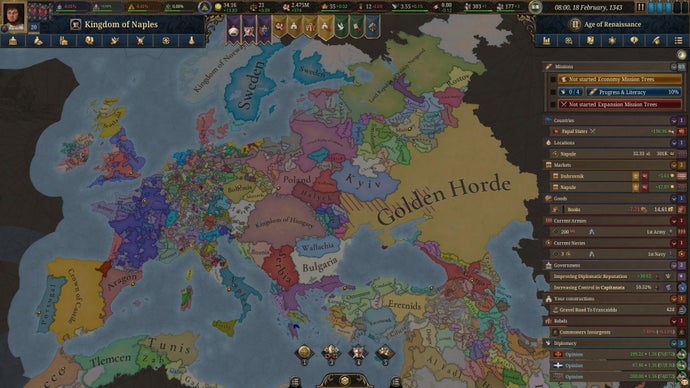
The “one more year” compulsion is a well-documented phenomenon among Paradox grand strategy enthusiasts, and Europa Universalis 5 amplifies this to an almost unprecedented degree. Progress in the game occurs on a year-by-year basis, and each passing year brings new events, challenges, and opportunities. Whether you are waiting for a crucial technology to unlock, a diplomatic event to resolve, or an army to complete its siege, it’s incredibly difficult to disengage. You’ll find yourself thinking, “Just one more year to see if this trade agreement goes through,” or “One more year to finish this construction project.” This leads to exceptionally long play sessions, where hours can melt away unnoticed. Our own Neapolitan campaign, spanning 150 years in a mere 45 hours of gameplay, is a testament to this. The pace of development, the slow burn of empire building, and the gradual unfolding of long-term consequences create an experience that is both marathon-like and intensely rewarding.
Mastering the Mechanics: A Deeper Look at Europa Universalis 5
To truly excel in Europa Universalis 5, a deep understanding of its multifaceted mechanics is essential. This is not a game where brute force alone guarantees victory; it is a game of nuance, foresight, and meticulous planning.
Economy and Trade: The Lifeblood of Nations
A robust economy is the foundation upon which any successful empire is built. Europa Universalis 5 features an elaborate economic simulation that encompasses taxation, production, and, most importantly, trade. Players must carefully manage their provinces, investing in buildings that boost production, manpower, and tax income. The global trade system is particularly fascinating, with valuable trade goods flowing along established routes. Controlling key trade nodes and establishing a strong merchant navy is paramount to siphoning wealth from your rivals and funding your military endeavors. We’ve learned that prioritizing investments in provinces with high base tax and valuable trade goods can significantly accelerate early game development, allowing for quicker expansion and technological advancement. The management of inflation and national debt also presents a constant strategic consideration.
Trade Route Dynamics
The flow of trade is a critical element. Players can direct trade wealth towards their home node by building marketplaces, employing merchants, and projecting naval power to protect their shipping lanes. Conversely, rival nations will attempt to siphon this wealth away. Understanding the value of different trade goods and the geographical importance of trade nodes is key to economic dominance. We have found that focusing on controlling the Silk Road nodes or the English Channel trade node can yield immense profits, but often requires significant military investment to defend.
Diplomacy and Grand Strategy: The Art of the Deal
Diplomacy in Europa Universalis 5 is as complex and vital as any military campaign. The diplomatic interface allows for a vast array of interactions, from forging alliances and royal marriages to issuing ultimatums and declaring war. Relations between nations are influenced by factors such as cultural and religious commonalities, rivalries, diplomatic reputation, and the ever-present threat of aggressive expansion.
Alliance Networks and Royal Marriages
Building and maintaining strong alliances is a cornerstone of survival and expansion. A well-placed alliance can deter aggression, provide crucial military support in times of war, and even enable dynastic succession through royal marriages. We’ve often found ourselves relying on powerful allies to win wars against numerically superior foes, highlighting the importance of cultivating strong diplomatic ties. The succession mechanics tied to royal marriages can lead to unexpected personal unions, dramatically altering the geopolitical landscape without a single shot being fired.
Aggressive Expansion and Coalitions
The Aggressive Expansion (AE) system serves as a crucial balancing mechanism. Every act of conquest or significant diplomatic transgression generates AE, which can lead to rival nations forming coalitions against you. Managing AE is a delicate art, requiring players to balance their expansionist desires with the need to maintain peace and avoid becoming the target of a global alliance. We have learned that launching multiple, smaller wars over a shorter period can sometimes be less impactful on AE than one massive conquest, allowing for more sustained growth.
Warfare and Military Might: The Instruments of Power
While diplomacy can achieve much, the ultimate arbiter of power in Europa Universalis 5 is often military might. The game features a detailed military system that accounts for unit types, terrain, general quality, morale, and discipline.
Army and Navy Composition
The composition of your armies and navies is crucial. Different unit types have strengths and weaknesses, and investing in the right technologies unlocks more powerful and efficient units. Understanding the combat width, the impact of terrain on battles, and the importance of high-quality generals can turn the tide of even the most desperate engagements. We’ve experienced firsthand how a well-led army with superior discipline can defeat a larger, less experienced force.
Naval Power and Colonial Expansion
Naval power is equally important, especially for nations with overseas ambitions. Building and maintaining a fleet is essential for protecting trade routes, projecting power across continents, and enabling colonial expansion. The exploration and colonization mechanics are deeply intertwined with naval capabilities, allowing players to discover new worlds and establish lucrative overseas empires. Securing naval supremacy in key waters can also effectively blockade enemy ports, crippling their economies.
Technology and Ideas: The Engine of Progress
Technological advancement and the adoption of national ideas are fundamental to long-term success. Europa Universalis 5 features three distinct technology categories: Administrative, Diplomatic, and Military. Investing in these trees unlocks new buildings, unit types, diplomatic options, and military tactics.
National Ideas and Traditions
National ideas are unique to each playable nation and provide powerful, passive bonuses that reflect their historical strengths and characteristics. Choosing which national ideas to adopt and when to unlock them can significantly shape a nation’s development and strategic focus. We’ve found that nations with strong early-game military ideas can snowball into formidable powers, while those with economic or diplomatic bonuses require a more patient, strategic approach.
Idea Groups and Their Impact
Beyond national ideas, players can adopt idea groups, which offer broad bonuses across various aspects of gameplay. From the Exploration idea group that unlocks overseas expansion to the Quality idea group that enhances military effectiveness, the selection of idea groups can profoundly influence a nation’s trajectory. Choosing the right combination of idea groups to complement your national ideas and strategic goals is a vital part of long-term planning.
Internal Management: Stability, Religion, and Culture
The internal stability of your nation is just as important as its external relations. Europa Universalis 5 incorporates complex systems for managing stability, religion, and culture.
Stability and Unrest
Maintaining national stability is crucial to prevent widespread unrest and rebellion. Factors such as war exhaustion, low legitimacy, and negative events can decrease stability, leading to costly uprisings. Conversely, high stability provides various bonuses, including increased tax income and reduced unrest. We’ve learned that strategically using monarch points to increase stability after a costly war or a series of negative events is often a worthwhile investment.
Religious and Cultural Dynamics
The religious and cultural landscape of Europa Universalis 5 is rich and dynamic. Different religions have unique mechanics, doctrines, and relationships with one another, while cultural acceptance and conversion play a significant role in unifying your empire. The Reformation and Counter-Reformation periods, for instance, can dramatically reshape the religious map of Europe, leading to intense conflict and shifting alliances. Navigating these religious and cultural divides, or actively promoting conversion, can be a central challenge of many playthroughs.
The Europa Universalis 5 Experience: A Marathon, Not a Sprint
It is imperative to acknowledge that Europa Universalis 5 is a game that demands significant time investment. As our own 45-hour Neapolitan journey through just 150 years illustrates, this is not a title for the impatient. However, this glacial pace of progress is precisely what lends the game its depth and its unique charm.
The Joys of Long-Term Planning
The long-term planning inherent in Europa Universalis 5 is one of its most satisfying aspects. Decisions made in the 15th century can have ramifications that echo through centuries. Building a strong navy early might seem like a minor investment, but it can lay the groundwork for a colonial empire that dominates the world by the 18th century. Fostering good relations with a specific neighbor might prevent a future war, allowing you to focus your resources elsewhere. This sense of historical causality and the ability to shape the destiny of nations over vast stretches of time is what truly sets Europa Universalis 5 apart.
The Learning Curve and the Reward
We will not shy away from the fact that Europa Universalis 5 possesses a steep learning curve. The sheer number of interconnected mechanics and the vastness of the simulation can be overwhelming for newcomers. However, the reward for perseverance is immense. Every new concept mastered, every strategic hurdle overcome, and every successful campaign meticulously orchestrated provides a deep sense of accomplishment. We encourage new players to embrace the learning process, to experiment, and to not be afraid of making mistakes. Each playthrough offers valuable lessons, and with time and dedication, you will begin to unravel the intricate tapestry of the game’s strategic possibilities.
Replayability: An Unending Saga
The replayability of Europa Universalis 5 is, quite simply, infinite. With over 500 playable nations, each possessing unique starting conditions, ideas, and historical trajectories, no two campaigns will ever be the same. The dynamic nature of the AI, the emergent events, and the sheer freedom to forge your own path ensure that you can return to this game year after year and still discover new challenges and experiences. Whether you aim to conquer the world as a minor power, establish a trade empire, or simply survive the tumultuous early modern period, Europa Universalis 5 offers an unparalleled sandbox for historical storytelling.
Conclusion: Europa Universalis 5 - A Legacy of Grand Strategy
In conclusion, Europa Universalis 5 is a monumental achievement in the grand strategy genre. It is a game that challenges, rewards, and utterly captivates its players. For those who crave deep strategic thinking, historical immersion, and the thrill of shaping the destiny of nations over centuries, there is no finer experience to be found. While it demands dedication and a willingness to invest significant time, the rewards are commensurate. We at Gaming News can attest that the journey through its intricate systems, its dynamic historical simulation, and its boundless possibilities is one that will stay with you long after the last province has been conquered. Europa Universalis 5 is not just a game you play; it is a world you inhabit, a history you rewrite, and a legacy you forge. It is, without a doubt, the pinnacle of grand historical strategy.