Consume Me Review - A Delightful Diet Diary: An In-Depth Exploration
At Gaming News, we approach every title with a dedication to comprehensive analysis, aiming to deliver insights that resonate with players and offer a deeper understanding of the gaming experience. Today, we delve into the nuanced world of Consume Me, a PC title developed by Jenny Jiao Hsia, AP Thomson, Jie En Lee, Violet W-P, and Ken “coda” Snyder, and published by Hexecutable. Released on September 25, 2025, this game tackles a subject matter rarely explored in interactive media: the intricate and often painful landscape of teenage insecurities, particularly those surrounding body image and disordered eating. Our rigorous evaluation, conducted on the PC platform, seeks to provide a definitive perspective on this unique and thought-provoking game.
Understanding the Core Concept: Gamifying Real-Life Insecurities
Consume Me presents a brave and unconventional premise: it transforms a high school girl’s struggles with her diet and self-perception into engaging, albeit challenging, gameplay mechanics. This approach is immediately signaled by a thoughtful and explicit content warning at the outset, which not only alerts players to the sensitive nature of the themes but also emphasizes that the depicted dieting behaviors are not recommended or to be emulated. This foundational aspect of the game is crucial, as it establishes Consume Me not as a guide to dieting, but as a profound commentary on the dangers of applying rigid, quantifiable game systems to the complexities of real human experiences, especially those involving mental and emotional well-being.
The narrative centers on Jenny, a character based on one of the game’s creators. As she approaches her senior year of high school, a seemingly innocuous comment from her mother about her weight triggers a drastic shift in her behavior. Jenny embarks on a rigorous dieting regimen, meticulously tracking every calorie and exercise session. This core gameplay loop is interwoven with the management of other vital aspects of her life: household chores, financial resources, and academic responsibilities. Each of these activities is ingeniously translated into distinct minigames, reminiscent of the rapid-fire, often eccentric challenges found in the WarioWare series.
These minigames are characterized by their expressive art style, a hallmark of Consume Me. While some are undeniably charming and enjoyable, others present a welcome, albeit occasional, challenge. Crucially, even the less preferred minigames are designed to be brief, ensuring that the player’s engagement remains high without becoming tedious. Despite its narrative-first design, Consume Me successfully fosters a sense of anticipation, compelling players to return and actively participate in managing Jenny’s evolving and often toxic behaviors. This creates a unique dynamic where the player is both an observer and an active participant in Jenny’s journey, leading to a deeply personal and immersive experience.
The Gameplay Loop: A Delicate Balancing Act
At the heart of Consume Me’s gameplay is the “build Jenny’s lunch plate” mechanic. This system functions as a sophisticated puzzle, where players must arrange food items, represented as Tetris-like pieces, onto a grid. The objective is to fill specific “hunger squares” while strategically avoiding “empty ones.” Each food item carries a distinct “bite” cost, an abstract representation of calories, demanding a constant interplay between fitting pieces effectively and selecting healthier options to keep the bite count within Jenny’s daily limit. Exceeding this limit triggers mandatory exercise sessions, which consume valuable in-game time that could otherwise be allocated to other essential tasks. Conversely, failing to adequately fill the hunger squares results in a depleted energy meter, creating a cascade of negative consequences.
This puzzle element, despite its connection to a distressing goal, is remarkably engaging. We found ourselves genuinely looking forward to the daily ritual of constructing Jenny’s lunch, a testament to the game’s design. The subtle yet impactful feedback loop within this mechanic is particularly noteworthy. For instance, opting for a “light lunch” – an alternative meal unlocked later in the game that costs fewer bites – leads to a dip in Jenny’s energy levels. To compensate, players might turn to energy drinks, which provide a swift but temporary boost. However, this reliance on caffeine introduces a new set of challenges, such as persistent headaches. The only effective remedy for these headaches involves activities that improve Jenny’s mood. The most readily available solution is often indulging in a bag of chips, which, ironically, pushes Jenny back over her bite goal, perpetuating the very cycle the player is trying to escape.
This ingenious design creates an almost inescapable trap, mirroring the insidious nature of real-life eating disorders. We found ourselves caught in this cycle, realizing the detrimental path Jenny was on only when it was too late to easily course-correct. This “genius trap” is a powerful example of Consume Me’s ability to communicate complex psychological states through interactive gameplay. It’s a form of artistic expression and education that is uniquely suited to the video game medium, offering insights that are difficult to convey through other forms of media.
Visual and Narrative Charm: Personality in Pixels
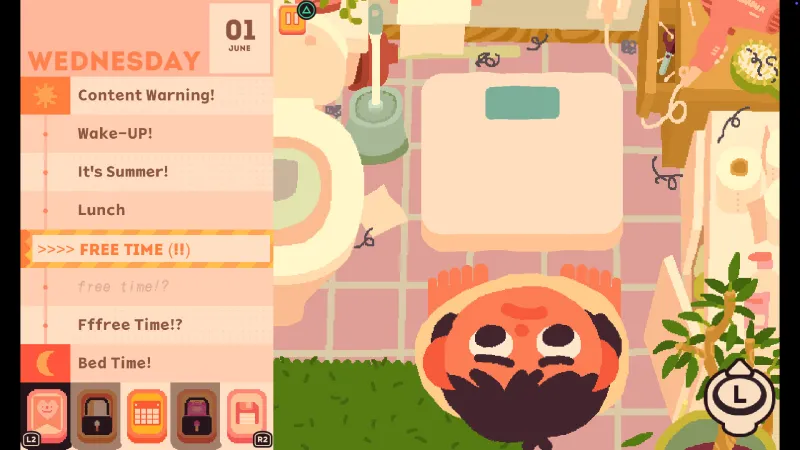
The art and animation in Consume Me exude a remarkable amount of personality. The pixel art style, with its hand-drawn aesthetic, brings the characters to life, particularly through their hyper-expressive faces. During cutscenes, player interaction is limited to simple swipes of the mouse or joystick, often leading to unexpected and delightful actions from Jenny. Whether she’s nervously picking up a dollar from the sidewalk or struggling to get out of bed, these moments are infused with a sense of relatable vulnerability.
Despite the potentially somber subject matter, Consume Me avoids a dour visual tone. Instead, its vibrant and expressive presentation serves to offset the very real stress experienced by players as they navigate Jenny’s life. It also effectively represents how the struggles of eating disorders can often be invisible to the outside world, hidden beneath a seemingly normal facade.
The moment-to-moment dialogue writing is equally sharp. Jenny emerges as a memorable and endearing protagonist, a character whom players can easily empathize with and root for. We found ourselves readily adopting her perspective, transitioning from detached observers to invested participants who genuinely felt nervous about completing homework assignments and earnestly hoped for positive social interactions, such as a boy reciprocating her affections. This strong narrative and character development are critical to the game’s success in making its sensitive themes resonate.
The Narrative Arc: Strengths and Stumbles
While we thoroughly enjoyed the game’s characters and the immersive experience of its early hours, the final chapter of Consume Me presents a few areas where the narrative falters. A notable addition in the latter stages of the game is the introduction of religion as a source of comfort for Jenny, complete with a musical prayer sequence. Conceptually, this inclusion is not inherently problematic, but its sudden appearance and apparent irrelevance to the overarching narrative felt out of place. Religion is not significantly explored prior to this point, and its impact on Jenny’s journey becomes minimal by the story’s conclusion.
The gameplay associated with prayer allows Jenny to pray once a day, theoretically removing mental blocks that hinder her studies. This action also provides a slight boost to her mood, energy, and hunger bars. While improving her mood aligns with the game’s themes, the impact on her energy and hunger meters feels inconsistent with Consume Me’s central message. A core flaw of Jenny’s behavior is her belief that sheer mental effort can force her body into unhealthy levels of productivity, whether through extreme dieting or prolonged wakefulness. The existence of prayer as a consequence-free energy booster or a substitute for eating undermines this critique, introducing a narrative element that feels at odds with the game’s established mechanics and themes.
When Consume Me culminates in the tragic spiral foreshadowed by its content warning, religion does not appear to offer a definitive solution. Although Jenny is eventually “saved” in a subsequent chapter, the religious element is quickly and unceremoniously set aside. This highlights the inherent difficulty in concluding biographical narratives, particularly when the subject is still alive. Real-world events that form the compelling premise of a story rarely resolve with clean, definitive endings. In Consume Me, the primary sources of dramatic tension seem to dissipate, with Jenny ultimately outgrowing her struggles rather than confronting them head-on in a cathartic resolution.
Adding to this sense of anticlimax, the game shifts focus to Jenny’s recovery after her rock-bottom experience. The player, having navigated Jenny’s descent, is then relegated to watching a slightly interactive montage of her subsequent ascent. The entire game builds towards her inevitable crash, where she confronts the destructive nature of her behaviors. However, the moment this crash occurs, the game effectively concludes. It’s akin to a platformer where the protagonist finally reaches the end, only to witness a cinematic of their victory rather than participating in a final boss battle. The narrative is present, but as a player, we are forced to conclude on a note of loss, having been denied agency in the resolution of Jenny’s most critical moment of reckoning.
The Verdict: A Compelling Message Despite an Underwhelming Finale
The concept of gamifying one’s food habits is, unequivocally, an awful idea, and Consume Me illustrates this point with a compelling and entertaining approach. Even if players disregard the initial content warning, the game’s central message is powerfully conveyed from its opening moments. Had its ending not faltered, Consume Me could have easily ascended to the ranks of our all-time favorite titles. Nevertheless, there remains a substantial amount to admire and appreciate within the game, despite its somewhat underwhelming conclusion.
Consume Me is brimming with creativity, personality, and a profound emotional resonance. Its courageous exploration of sensitive themes, delivered through engaging gameplay and a visually distinctive art style, has undoubtedly earned it a special place in our hearts. The developers have crafted an experience that is both artistically significant and emotionally impactful, offering a unique perspective on issues that deserve greater representation in the gaming world.
The game’s ability to translate complex psychological states into tangible gameplay mechanics is its greatest triumph. The cyclical nature of Jenny’s struggles, the constant tension between her desires and her well-being, and the subtle ways her behaviors intersect with her daily life are all masterfully depicted. Players are not merely observing a story; they are actively participating in its unfolding, experiencing the anxieties and the small victories alongside Jenny. This level of immersion is rare and speaks volumes about the power of interactive storytelling.
Furthermore, the game’s meta-commentary on the limitations of quantitative measurement in addressing qualitative human issues is particularly salient. In a world increasingly driven by data and metrics, Consume Me serves as a vital reminder that some of the most important aspects of life cannot be easily quantified or solved with a strategic approach. The “bite” system, while a clever gameplay mechanic, also functions as a poignant metaphor for the flawed logic of reducing complex issues like self-worth and health to mere numbers.
The developers, Jenny Jiao Hsia, AP Thomson, Jie En Lee, Violet W-P, and Ken “coda” Snyder, deserve commendation for their bravery and artistic vision. Creating a game that tackles such a sensitive subject with such nuance and respect is no small feat. The personal touch evident throughout the game suggests a deep well of introspection and a genuine desire to connect with players on an emotional level. This authenticity is what elevates Consume Me beyond a mere entertainment product into a meaningful work of art.
While the narrative’s conclusion leaves something to be desired, it does not detract from the overall significance of Consume Me. The journey itself is undeniably powerful, and the lessons learned along the way are profound. The game encourages empathy, fosters understanding, and prompts introspection, all while providing a unique and memorable gaming experience. For these reasons, Consume Me stands as a commendable achievement in indie game development and a vital contribution to discussions surrounding mental health and self-perception in the digital age.
Score: 8.25
Reviewed on: PC Platform: PC Publisher: Hexecutable Developer: Jenny Jiao Hsia, AP Thomson, Jie En Lee, Violet W-P, Ken “coda” Snyder Release: September 25, 2025