Rockstar Games Faces Accusations of Union Busting as Fired Developers Spark Street Protests and Legal Scrutiny
Gaming News has been closely monitoring a rapidly escalating situation involving Rockstar Games, the celebrated developer behind iconic titles like Grand Theft Auto and Red Dead Redemption. A recent wave of dismissals, affecting approximately 30 UK-based employees, has ignited a firestorm of controversy, with accusations of union busting and retaliation taking center stage. The situation has culminated in street protests organized by the IWGB Game Workers Union and intense scrutiny directed at Rockstar’s parent company, Take-Two Interactive. This detailed report delves into the accusations, the defenses presented, and the broader implications for the gaming industry.
Rockstar Games Under Fire: Allegations of “Gross Misconduct” and Retaliation
The saga began last week with Rockstar Games announcing the abrupt termination of around 30 employees based in the United Kingdom. The company cited “gross misconduct” as the official reason for these dismissals. However, this explanation has been met with fierce opposition from the IWGB Game Workers Union, a vocal advocate for workers’ rights within the games sector.
The union has vehemently denied Rockstar’s claims, asserting that the firings are not a consequence of any wrongdoing by the employees but rather a calculated act of retaliation. According to the IWGB, these developers were dismissed precisely because they were actively engaged in the process of attempting to unionize. This, the union stresses, is a fundamental right protected under UK law.
In a strongly worded statement, the IWGB branded Rockstar’s actions as “the most blatant and ruthless act of union busting in the history of the games industry.” This accusation carries significant weight, given the industry’s history of intense work cultures and the growing movement among game developers to establish collective bargaining power. The union’s stance suggests a deliberate effort by Rockstar to suppress nascent unionization efforts before they could gain traction within the company.
The implications of such an accusation are far-reaching. If proven, it could lead to severe reputational damage for Rockstar Games, a studio already known for its demanding development cycles and intense work environments. It also raises serious questions about the ethical responsibilities of major game development studios towards their workforce and their adherence to labor laws. The union’s immediate and forceful response indicates a commitment to challenging Rockstar’s narrative and advocating for the rights of the dismissed employees.
Rockstar’s Defense: Accusations of Leaking “Confidential Information”
In response to the escalating accusations from the IWGB, Rockstar Games has issued its own statement. Speaking to Bloomberg, the company pushed back against the union’s narrative, offering a different perspective on the dismissals.
Rockstar’s official statement accuses the fired employees of sharing “confidential information on a public forum.” This defense suggests that the terminations were a necessary measure to protect proprietary information and intellectual property, a common concern for any company operating in a competitive industry. The company’s focus on the alleged dissemination of sensitive data implies that the misconduct in question was a breach of trust and a violation of their employment agreements.
The term “confidential information” is broad and could encompass a range of sensitive details, from unannounced project plans and financial data to internal communications and development strategies. The suggestion that this information was shared “on a public forum” implies a level of recklessness or deliberate intent to harm the company’s interests by the affected staff. This defense seeks to reframe the narrative, painting the company as the victim of a security breach rather than an aggressor against its employees.
However, Rockstar’s explanation has also been met with strong counterclaims. The IWGB has directly challenged the characterization of the alleged “public forum,” asserting that the communication channel used by the developers was far from public.
IWGB’s Rebuttal: A Private Discord Channel, Not a Public Forum
The IWGB Game Workers Union has vehemently refuted Rockstar’s claim that confidential information was shared on a public forum. According to the union, the “public forum” alluded to by Rockstar was, in fact, a private Discord channel.
This Discord server, the IWGB insists, was established as a secure space for IWGB members and Rockstar developers to discuss working conditions and unionisation efforts. The purpose was to foster an environment where employees could openly share their concerns, strategize about collective action, and gather support without fear of immediate reprisal. The union argues that sharing information within such a private, encrypted channel, designed for internal discussion among union members and potential members, does not constitute the public dissemination of confidential data.
The union’s clarification is critical. It shifts the focus from a potential leak of sensitive company information to an alleged attempt to surveil and punish employees for engaging in protected, private discussions related to their employment rights. If Rockstar was monitoring this private channel and using its contents as justification for termination, it would raise serious legal and ethical questions regarding employee privacy and the right to organize.
The IWGB’s stance suggests that Rockstar’s accusation is a disingenuous attempt to legitimize what they believe to be an unlawful act of union busting. By labeling a private discussion group as a “public forum,” Rockstar may be trying to create a false narrative that aligns with their alleged goal of deterring unionization. This distinction is crucial in any legal or public relations battle, as it directly impacts the perception of Rockstar’s actions and the validity of their defense.
Street Protests Erupt: Solidarity with Fired Rockstar Developers
In a powerful display of solidarity, the IWGB Game Workers Union has organized and led a series of street protests across the United Kingdom. These demonstrations are aimed at showing unwavering support for the Rockstar developers who were dismissed and to bring public attention to what the union considers a grave injustice.
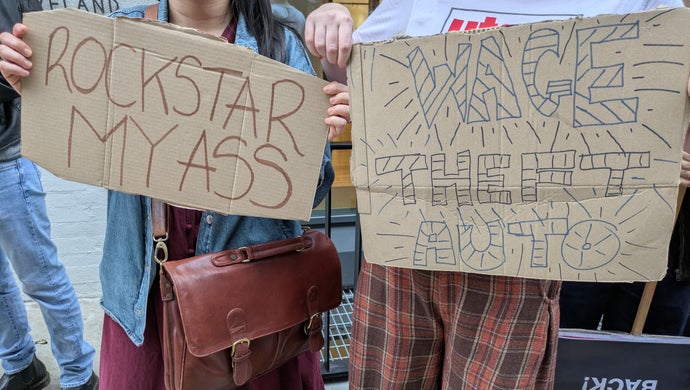
One such gathering, which Gaming News attended this morning, took place directly outside the London offices of Rockstar’s parent company, Take-Two Interactive. The protest saw a significant turnout of union members, affected employees, and concerned individuals from within and outside the gaming industry.
Chants of “Unionize!” and “Fair Work Now!” echoed through the streets as protestors held aloft banners and placards with messages condemning Rockstar’s alleged union-busting tactics. The atmosphere was one of determined protest, with participants expressing their anger and frustration over the company’s actions.
The choice to protest outside Take-Two Interactive’s offices is strategic. It directly targets the corporate entity that ultimately oversees Rockstar Games, placing pressure on the highest levels of management to address the concerns raised by the union. By demonstrating in front of the parent company’s headquarters, the IWGB aims to send a clear message that they will not back down and that the industry as a whole is watching.
These protests are not merely symbolic; they serve multiple vital purposes:
- Raising Public Awareness: The street demonstrations aim to capture media attention and inform the broader public about the plight of the fired developers. This public pressure can be a powerful tool in forcing companies to reconsider their practices.
- Demonstrating Solidarity: The presence of numerous supporters reassures the dismissed employees that they are not alone and that their fight for justice has widespread backing. This moral support is invaluable during a challenging period.
- Exerting Pressure on Take-Two: By making their presence felt physically at Take-Two’s offices, the union directly confronts the company with the human cost of their alleged actions. This can create an uncomfortable environment for the company and encourage a more conciliatory approach.
- Setting a Precedent: Successful protests and unionization efforts can inspire other game developers facing similar issues to organize and demand better working conditions.
The IWGB’s commitment to visible action underscores their belief in the righteousness of their cause and their determination to fight for the rights of game workers. The ongoing nature of these protests suggests that this conflict is far from over and that further actions can be expected.
The Legal and Ethical Landscape: Employee Rights in the UK Games Industry
The events at Rockstar Games highlight a critical intersection of labor law, corporate ethics, and the evolving landscape of the video game industry. In the United Kingdom, employees have legal rights to organize and join trade unions. These rights are enshrined in legislation designed to protect workers from unfair dismissal and to ensure a fair balance of power between employers and employees.
The Trade Union and Labour Relations (Consolidation) Act 1992 provides a framework for union recognition and protection against anti-union discrimination. According to UK law, employers are prohibited from dismissing an employee because they are a member of a trade union or because they have participated in union activities. Any dismissal that can be proven to be a direct consequence of such activities could be deemed unfair dismissal, leading to potential legal recourse for the affected employees.
The IWGB’s assertion that Rockstar’s firings constitute “union busting” is a serious legal allegation. If the union can demonstrate a causal link between the employees’ unionization efforts and their dismissal, they may have grounds to pursue legal action against Rockstar Games and potentially Take-Two Interactive. This could involve claims of unfair dismissal, unlawful discrimination, and potentially damages for loss of earnings and reputational harm.
Furthermore, the alleged use of private communications for disciplinary action raises questions about employee privacy. While employers have legitimate interests in protecting confidential information, their methods of investigation and enforcement must comply with data protection laws and respect employees’ reasonable expectations of privacy, particularly within dedicated communication channels for union activities.
The broader context of the games industry is also relevant. This sector has historically been characterized by demanding crunch periods, long working hours, and a sometimes-unstable employment model. The growing movement towards unionization within the games industry reflects a desire among developers for greater job security, fairer compensation, and a more sustainable work-life balance. Incidents like the Rockstar dismissals can either serve as a deterrent to such movements or, conversely, galvanize them further by demonstrating the perceived need for collective representation.
The outcome of this situation could have significant repercussions for labor relations within the UK games industry. A successful challenge by the IWGB could embolden other developers to organize, while a victory for Rockstar might reinforce the perception that unionization efforts can be effectively suppressed.
Take-Two Interactive’s Role and Responsibility
As the parent company of Rockstar Games, Take-Two Interactive stands at the center of this controversy. While Rockstar Games is the entity directly involved in the dismissals, Take-Two Interactive holds ultimate oversight and accountability for the practices of its subsidiaries.
The IWGB’s decision to protest outside Take-Two’s offices underscores the understanding that decisions of this magnitude are often influenced or dictated by corporate leadership at the highest level. Take-Two Interactive is a publicly traded company, and its corporate governance and labor practices are subject to scrutiny by investors, regulators, and the public.
The company’s response to this situation will be critical in shaping its reputation and its future relationships with its workforce. Silence or a purely defensive posture could be interpreted as an endorsement of Rockstar’s alleged actions. Conversely, a proactive engagement with the union and a transparent investigation into the firings could demonstrate a commitment to ethical conduct and fair labor practices.
Key considerations for Take-Two Interactive include:
- Reputational Management: The negative publicity surrounding these allegations can significantly impact Take-Two’s brand image, potentially affecting sales, investor confidence, and the ability to attract top talent.
- Investor Relations: Socially responsible investing (SRI) and environmental, social, and governance (ESG) factors are increasingly important for investors. Allegations of union busting and unfair labor practices can raise red flags for investors prioritizing ethical operations.
- Legal Compliance: Take-Two must ensure that all its subsidiaries, including Rockstar Games, are operating in full compliance with UK labor laws. Failure to do so could result in costly legal battles and financial penalties.
- Employee Morale: The handling of this crisis can have a profound impact on the morale of the entire Take-Two workforce, including employees at other studios within their portfolio. A perceived lack of fairness or a dismissive attitude towards employee rights could lead to further unrest.
The coming weeks and months will likely see further developments as the IWGB continues its advocacy and potentially pursues legal avenues. Take-Two Interactive’s approach to resolving this dispute will be closely watched and will set an important precedent for labor relations within the global gaming industry. The company has a crucial opportunity to demonstrate its commitment to its employees and to the principles of fair and ethical business conduct.
The Future of Unionization in the Gaming Industry
The ongoing situation at Rockstar Games is not an isolated incident but rather a symptom of a larger, growing movement within the gaming industry. Developers worldwide are increasingly seeking to organize and establish unions to address long-standing issues such as overwork, low pay, job insecurity, and a lack of creative control.
Recent years have seen a surge in unionization efforts across various game development studios, from independent outfits to major AAA publishers. These efforts are often met with resistance from employers, leading to contentious negotiations, legal challenges, and public disputes, much like the current situation with Rockstar.
The IWGB’s vocal advocacy and the organized protests demonstrate a determined push for greater worker power. The union’s strategy of leveraging public opinion and engaging in direct action highlights a commitment to achieving tangible improvements in working conditions.
The implications for the future of unionization in the gaming industry are significant:
- Increased Worker Voice: Successful unionization efforts can lead to more equitable power dynamics between employers and employees, giving developers a stronger voice in decisions that affect their careers and well-being.
- Improved Working Conditions: Unions can negotiate for better wages, reasonable working hours, paid time off, and improved benefits, helping to create a more sustainable and less exploitative work environment.
- Enhanced Job Security: Collective bargaining agreements can provide greater job security, offering protection against arbitrary dismissals and establishing clearer processes for performance management.
- Industry-Wide Standards: As more studios unionize, there is the potential for the establishment of industry-wide standards for labor practices, which could benefit all workers in the sector.
- Challenges and Setbacks: The path to widespread unionization is not without its obstacles. Employers often employ sophisticated strategies to discourage union activity, and legal frameworks can sometimes be slow to adapt to the evolving nature of work.
The current conflict between Rockstar Games and the IWGB Game Workers Union serves as a critical case study. The way this dispute is resolved, whether through legal means, negotiation, or continued public pressure, will undoubtedly influence the trajectory of unionization efforts within the global gaming industry for years to come. The determination shown by the IWGB and the solidarity displayed at the protests suggest that game workers are increasingly unwilling to accept exploitative practices and are prepared to fight for their rights.
Gaming News will continue to provide in-depth coverage of this developing story, offering comprehensive analysis and updates as new information emerges. The future of labor in the gaming industry may well be shaped by the events unfolding today.